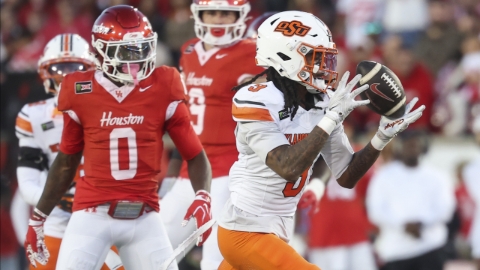
I started writing this article during the game this past Saturday. But after several revisions, I came to the conclusion it needed to wait and simmer. It’s always good to give yourself 24 hours to gain perspective. Then I told myself to wait until at least Monday — to see the fan reaction, to take in the national coverage, and to step back from the raw emotions of a blowout loss.
Oklahoma State didn’t just lose at Oregon — it got exposed. The 69–3 final score was one point shy of the worst loss in program history, dating back to 1907.
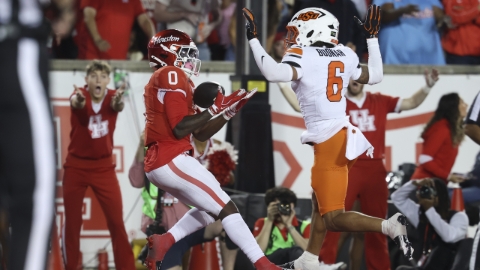
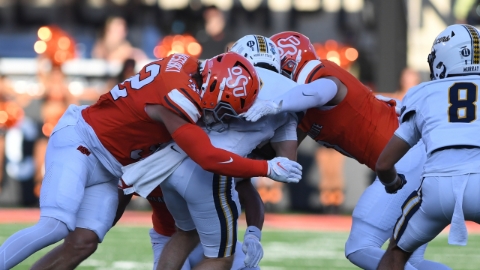
The offensive line held up better than many expected, but the cracks showed everywhere else. Receivers couldn’t win contested catches. The defense bent early, then broke — Oregon quarterbacks had clean pockets, and their receivers ran free. By halftime, the outcome wasn’t in doubt.
Even Gundy’s family could feel the weight. His son jumped on social media to defend him, a gesture that may have come from loyalty but instead looked like desperation. Meanwhile, veteran voices like Bill Haisten were already speculating publicly that the end of the Gundy era might finally be near.
But the real story wasn’t what happened on the field. It was who was watching.
A contingent of Oklahoma State’s university leadership made the trip to Eugene. That wasn’t coincidence — it was intention. They wanted to see the product for themselves. And they picked a night where OSU could not have looked worse.
This past summer, for the first time, leadership required Gundy and his staff to present a full review of roster additions and revenue-sharing dollars. That meeting happened. But the impression wasn’t about whether the roster was improving — it was about how much was being spent. Dollars and optics, not talent and results.
Leadership circles had already wanted Gundy gone last year. The only reason he survived was because Dr. Shrum stood in the way. And what happened to her? She’s gone. Officially, you’ll hear one explanation. But the whispers in Stillwater suggest otherwise: money, politics and power.
Take the vet school. $250 million was the initial figure. Did anyone really believe Dr. Shrum — a physician by training — was going to sink that kind of money into a single silo? What I’ve been told is that she intended to spread those resources across the university, supporting both academics and athletics. Instead, that vision was hijacked. And now? There’s talk someone at the top wants their name stamped on that vet school.
And here’s the kicker: while OSU was getting steamrolled in Eugene, the radio broadcast was bragging about the soon-to-be $328 million vet school.
Now, to be clear — vet school funding isn’t the same pool as athlete revenue sharing or NIL. The former comes from state allocations, the latter depends on private donors and new NCAA revenue-sharing frameworks. Two different buckets. But optics matter. While OSU leaders were celebrating a $328 million vet school in the middle of a football embarrassment, Oregon was still basking in the glow of a recent $2 billion donation from Phil Knight for its cancer research center. And Knight’s billions don’t just stop at academics — they power Oregon athletics too.
That’s the gulf Oklahoma State is staring across.
And here’s the problem: OSU isn’t just losing ground nationally. It’s losing it inside the Big 12.
Look at Texas Tech. They didn’t just set up a collective — they put Cody Campbell, their biggest donor, in a position of influence at the very top. Governor Greg Abbott appointed him to the Texas Tech System Board of Regents in 2021, and this year he was elected Chairman. He helped fund renovations of Tech’s athletic facilities, and the football field at Jones AT&T Stadium now bears his name: Cody Campbell Field. And with John Sellers, he co-founded Tech’s NIL collective, the Matador Club.
That’s alignment. Money, power, NIL, facilities — all moving in the same direction. Tech is aggressive in the portal, visible in NIL, and looks like a program built for the new era.
That’s what OSU is up against. A peer institution that weaponized its donor base and leadership structure to get ahead. Meanwhile in Stillwater, oversight meetings nitpick expenditures and donors are left to figure out NIL on their own.
If Texas Tech can harness its resources this way, why can’t Oklahoma State? That’s the uncomfortable question hanging in the air.
This is where the national conversation falls flat. CBS just ran the easy column: “Mike Gundy built Oklahoma State’s modern identity, but now it’s time for a new one.” That’s clean. It gives Gundy credit, declares his time is over, and wraps a bow on the story.
But it misses what’s actually happening. The politics. The power plays. The way Shrum was pushed aside. The vet school. The fact that OSU’s leadership seems more concerned about prestige projects and revenue oversight than about putting a competitive football product on the field.
Gundy’s personality doesn’t fit that environment. He’s stubborn, dismissive, independent. That worked when the only fight was on the field. But in an era where optics, donor engagement, and revenue sharing matter as much as coaching, he’s the wrong man in the wrong moment.
For perspective: the worst loss in Oklahoma State history came 118 years ago — a 67-point beatdown by OU in 1907. On Saturday, Oregon came within a point of matching it. By the fourth quarter, it wasn’t about salvaging pride — it was about whether we were watching the lowest moment in program history unfold in real time.
That’s more than embarrassing. That’s institutional failure.
So maybe this really is the end of the Gundy era. His family defending him online, his inability to adapt to the new era of athlete compensation, and his personality clashing with leadership that wants control — all of it points in one direction. And with leaders sitting in those seats in Eugene, the timing of this loss couldn’t have been worse.
But here’s the truth: firing Gundy won’t fix everything. Until Oklahoma State stops bean-counting and starts treating football like it matters, the ceiling won’t change.
The 12-team College Football Playoff isn’t coming — it’s here. Last year, Arizona State even made the field. The Big 12 has a legitimate chance to place multiple teams in the bracket every season. Programs that adapt to NIL, revenue sharing, and modern donor engagement are going to seize that spotlight.
Texas Tech is already positioning itself to be one of them. Utah and BYU are resourceful, organized, and built to maximize every advantage. TCU, Colorado, and Iowa State are all pushing to stake their claim in the new order.
And where is Oklahoma State? Blaming Gundy as if he’s the only problem, while leadership avoids accountability for their own decisions. They’ll happily let him take the fall while ignoring their role in letting the program drift. Bragging about vet schools while football drowns is not a plan — it’s a dodge.
If nothing changes, the Cowboys won’t just miss another playoff. They’ll miss the playoff era altogether. And once you fall behind in this system, catching up is a long, uphill climb.
At the end of the day, this wasn’t a paycheck game. It was a reckoning. And right now, the Oklahoma State Cowboys are being run about as well as the Dallas Cowboys — asleep at the wheel, stuck in the past, and embarrassing themselves on the biggest stage. Different Cowboys, same problem.